GETTING
FROM GOOD FRIDAY TO EASTER
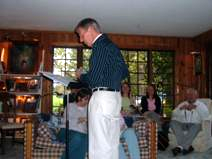
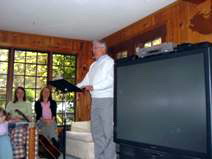
Easter Sermon 2006 at Inavale Farm
Text: “Very early on Sunday morning, at sunrise they
went to the grave.”
|
The problem
we have in Moment Ministries is that we not only have to get from Good Friday
to Easter, but we try to do it by going from Christmas Eve at the Deli to
Easter at Inavale Farm in one jump. Were we a traditional church, especially
a liturgical church like the Catholics or Lutherans, we would have prepared
better. As it is, we have no Ash Wednesday, no penitence, no period of denial,
no Palm Sunday, no Maundy Thursday Last Supper and betrayal, and no Good Friday.
Only Easter with a champagne brunch.
|
The point of this sermon is to remind
ourselves that you can’t really expect to have Easter without doing Good Friday.
|
Our text from the Gospel of Mark was
mentioned in this morning’s Gazette-Times. Did anyone read the paper this
morning? Only Joe. Anyway there was an article about the fact that scholars
are in disagreement about whether the Easter texts are accurate or even historical.
Mark’s Easter story is used as an example. Jean read the earliest version.
But as the article points out, two other endings were added. The first writer
ended with the ladies leaving the tomb frightened and telling nobody anything
about what they had seen. A later writer didn’t like that ending, so added
another. Still another writer added a much longer ending. By the time the
later gospels were written there were many versions of the story. All Easter
stories are “stories.”
|
But without the stories we wouldn’t
know the truth. Mark’s story imagines how it was for those women, going
out to the tomb that Sunday morning. I have seen those women going reluctantly
into McHenry’s Funeral Home when there is no funeral. I have been with those
ladies at the bedside when a beloved one breathed his last. I know that they
weren’t going in there with anything but leaden hearts. The story is full
of grief left over from Good Friday. Do you think they were saying, “Let’s
go to the tomb and celebrate Easter?” They were going grieving a terrible
loss. That’s the truth in his Easter story.
|
Another article in the paper this morning
tells Senator Gordon Smith’s story of the suicide of his son, and how the
devastating ache of that event still haunts him. You don’t wish such a man
“Happy Easter!” Not yet.
|
This week a colleague in ministry died.
I didn’t know him personally, although I’ve met him and admired him. He was
chaplain at Yale during the Civil Rights and Vietnam years. Those were days
when students rebelled against everything, including religion and church.
But when William Sloane Coffin preached, the chapel was full. He marched his
faith in the streets with the students, and sometimes went to jail with them.
He went on to be minister of the famed Riverside Church in New York City.
He preached his most memorable sermon there two weeks after his son was killed
in a car accident. He echoes what we hear in Mark’s story of the women on
Easter Sunday. “The reality of grief is the absence of God ─ ‘My God,
my God, why hast Thou forsaken me…” (Other quotes in our program are
from his book “Credo.”
|
There are all kinds of losses that are
as devastating. If you haven’t had a Good Friday in your life, you will. No
one gets though life, much less to Easter, without a Good Friday, when you
must deal with “a joy that has been taken away.”
|
When we hear the Easter stories it seems
like we go directly from weeping at the cross to joy at Easter, all between
Friday and Sunday. Thoughtful scholars have a different angle. Easter is
not a day, but an experience. We get that message from Senator Smith and
Bill Coffin and from any who have endured a Good Friday. I can tell you that
people don’t get over the loss of a beloved one in three days ─ or three weeks
─ or three months ─ or maybe not even in three years. Easter, like recovery
from grief, comes like a dawning. Darkness at first and maybe stormy, like
this morning. I looked out and caught a glimpse of the nearly full moon, soon
hidden by clouds. Gradually it began to be light. And after another long
while I looked out to see sunshine. It came and went, but finally it was
fully out. That’s the Easter experience.
|
So we realize that Easter is not
so much about what happened to Jesus, but what happened to those who loved
him. It was they who endured Good Friday and they who gradually had their
hearts and lives experience the light of Easter. The stories are all about
how Good Friday despair evolved into Easter joy.
|
Well, my job is to tell you the story
and help you see it and perhaps feel what it was like for those ladies on
their way from Good Friday toward Easter. And my job is to let you think of
your personal Good Fridays and what it takes to get where you can celebrate
your own Easter. Words of one of those songs we sang say the truth: “I
saw the light, I saw the light, No more darkness, no more night. Now I’m so
happy, no sorrow in sight. Praise the Lord, I saw the light.”
The good news is that we can get from Good Friday to Easter,
but we can’t get to Easter without facing up to Good Friday.
─ Art Morgan, Easter 2006 (April 16)
|
|